Who?
Young adults, primarily college students between the ages of 18 and 25, who care about their communities and want to make a positive impact.
Research findings from our competitive analysis, user interviews, and affinity mapping process.
| Dimension | Neighbors by Ring | NextDoor | Turn Up Activism | Change.org | Citizen | Reddit* |
|---|---|---|---|---|---|---|
| Primary focus | Real-time local safety and neighborhood awareness | Neighborhood discussion and local recommendations | Activism and cause-based mobilization | Petitions and digital advocacy | Crime, safety alerts, and incident reporting | Topic-based discussion and information sharing |
| Community connection | Medium | High | Medium | Low | Low | High |
| Location-based engagement | High | High | Medium | Low | High | Low |
| Pathway from awareness to action | Low | Low | High | Medium | Low | Low |
| Trust / verification | Medium | Medium | Medium | Medium | High | Low |
| Type of participation supported | Reporting and monitoring | Discussion and local exchange | Cause involvement and event participation | Signing and sharing petitions | Monitoring and reporting | Discussion and community posting |
| Target audience | General public, homeowners, and residents | Neighborhood residents, often older adults or homeowners | Civically engaged users and activists | General public interested in advocacy | General public concerned with local safety | Broad online communities organized by topic |
Our competitive analysis shows that existing platforms each support only part of the community engagement process. Some platforms, such as Citizen and Neighbors by Ring, emphasize real-time and location-based awareness. Others, like NextDoor and Reddit, support discussion and community exchange. Change.org and Turn Up Activism are stronger at mobilizing users around causes and action. However, no single platform effectively combines localized discovery, trusted information, community discussion, and clear next steps for involvement.
The analysis also reveals that most competitors are designed for broad public use rather than specifically for young adults. Many skew toward homeowners, general residents, or existing activists, leaving college-aged users without a platform tailored to how they discover opportunities, evaluate credibility, and decide to participate. This points to an opportunity for a youth-centered platform that connects awareness, trust, and action in one place, helping young adults move more easily from concern to meaningful community involvement.
Young adults, primarily college students between the ages of 18 and 25, who care about their communities and want to make a positive impact.
Individual semi-structured interviews, each lasting approximately 30 minutes.
To better understand our target audience, each team member conducted one semi-structured interview with a college student recruited through their extended networks. No identifying information was collected in our final research summaries in order to protect participant privacy.
We used a prepared question guide with open-ended prompts such as, “How do you stay updated on community events?” and “Do you find it easy or difficult to get involved in causes you care about?” This format allowed for consistency across interviews while still giving participants space to share their motivations, frustrations, habits, and experiences.
After the interviews, our team reviewed notes together and used FigJam to group recurring responses into broader themes, such as trust, barriers to involvement, access to timely information, and community connection. We then used repeated patterns and representative quotes from these clusters to develop our key insights. This process helped us move from individual responses to broader findings about how young adults currently engage with community issues and opportunities.
We used FigJam to synthesize our interview data through affinity mapping. Each team member added notes and quotes from their interviews, which were then grouped into clusters based on shared themes such as awareness, trust, barriers to action, and community connection. These clusters allowed us to identify patterns across participants and directly informed our key insights.
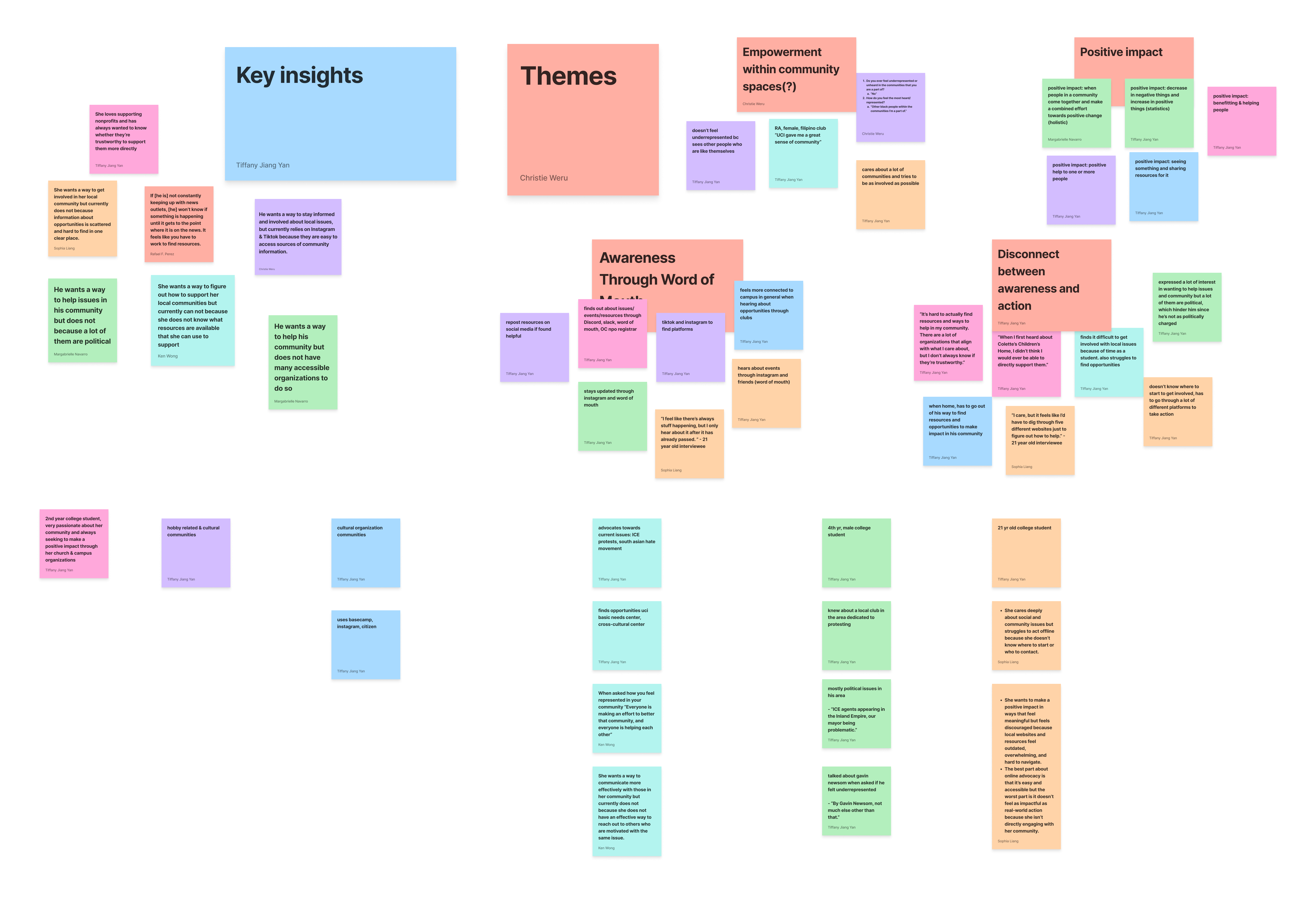
Across interviews, participants expressed hesitation in engaging with causes due to uncertainty about the credibility of organizations. Multiple participants described difficulty verifying whether opportunities were legitimate or worth their time.
“There are a lot of organizations that align with what I care about, but I don’t always know if they’re trustworthy.”
Without clear trust signals, even motivated users hesitate to take action.
Design implication: The platform should include verification cues, transparent organization details, and stronger trust signals.
Many participants expressed that they care about community issues but struggle to translate that awareness into action due to unclear steps and the high effort required.
“I care, but it feels like I’d have to dig through five different websites just to figure out how to help.”
When the pathway from awareness to action is unclear or time-consuming, users are less likely to engage.
Design implication: The platform should reduce friction by offering clearer next steps, centralized opportunities, and direct ways to get involved.
Participants described relying on informal and inconsistent channels for information, which often results in missed opportunities.
“I feel like there’s always stuff happening, but I only hear about it after it has already passed.”
Delayed and fragmented information limits participation even among users who want to be involved.
Design implication: The platform should provide centralized, timely, and location-relevant updates so users can act before opportunities pass.